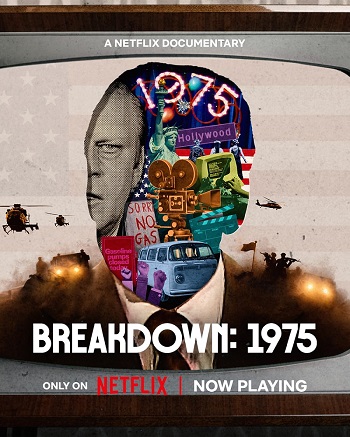
BREAKDOWN: 1975 (2025)
Featuring Patton Oswalt, Josh Brolin, Oliver Stone, Peter Bart, Wesley Morris, Joan Tewkesbury, Ellen Burstyn, Seth Rogen, Martin Scorsese, Albert Brooks, Peter Biskind, Naomi Fry, Rick Perlstein, Frank Rich, Todd Boyd, Sam Wasson, Jefferson Cowie, James Wolcott, Lawrence Hilton-Jacobs, Bill Gates, James Risen and Kurt Andersen.
Narrated by Jodie Foster.
Directed by Morgan Neville.
Distributed by Netflix. 92 minutes. Rated TV-MA.
Fifty years ago, filmmaking was in an interesting place. At that point, a group of young filmmakers – like Martin Scorcese, Francis Ford Coppola, Hal Ashby, Bob Rafelson, Robert Towne, George Lucas and many others – had put together an artistic utopia in which pretty much any story, no matter how dark and gritty, could be green-lit and consumed by a fascinated public. However, it was also a turning point for filmmaking because that summer the first blockbuster film Jaws changed all the rules.
This documentary, by filmmaker Morgan Neville (20 Feet from Stardom, Best of Enemies: Buckley vs. Vidal, Won’t You Be My Neighbor?, Roadrunner: A Film About Anthony Bourdain) argues that 1975 was the high-water mark for filmmaking and that is has been slowly sinking ever since. In fact, the Netflix blurb explaining the series states, “In 1975, as America faced social and political upheaval, filmmakers turned chaos into art. This documentary explores how a turbulent era gave rise to iconic movies like Taxi Driver, One Flew Over the Cuckoo’s Nest and Network.”
While I’m not sure I totally buy that, I will acknowledge that 1975 was a huge year for cinema. And perhaps I would buy documentarian Neville’s argument more if so many of the films that he discusses in Breakdown: 1975 weren’t actually released in other years. For example, 1976 is widely represented by the likes of Network, All the President’s Men, Taxi Driver, Rocky and The Bad News Bears. In fact, any one of those five titles were just as good as almost everything that was released in 1975. (And two of these 1976 films are featured examples in the blurb promoting the documentary.)
They also spend lots of time on films from 1974, such as Chinatown, The Towering Inferno, Death Wish, The Conversation, The Parallax View, and even Airport 1975, which actually did come out in October of 1974. Then there were further away titles like Easy Rider (1969), Shaft (1971), The Poseidon Adventure (1973), Jonathan Livingston Seagull (1973) and Star Wars (1977).
They also drop the ball on several TV shows, featuring All in the Family, which was still on but about four-five years into its run and not as revolutionary as it once was. Also discussed are Laverne and Shirley (which didn’t premiere until January 1976) and Wonder Woman (which aired its pilot movie in November 1975, but the actual series didn’t air until mid-1976).
Even the musical cues used here are mostly anachronisms. Some of the songs that are used in the background include Talking Heads’ “Psycho Killer” (1977), Tom Petty and the Heartbreakers’ “Breakdown” (1978), Heart’s “Crazy on You” (1977) and Devo’s “Jocko Homo” (1978). In fact, the only three songs that I can remember used here actually from the year being discussed are Donna Summer’s “Love to Love You Baby,” War’s “Why Can’t We Be Friends” and the Captain and Tennille’s “Love Will Keep Us Together.”
Which is kind of a shame, because while Neville is a terrific filmmaker, quite honestly, he has bitten off more than he can chew here. Trying to jam the year 1975 into an hour and a half would be hard enough, but then adding in all the other stuff makes this film feel awkward and unfocused. Particularly since the film uses the movies to illustrate other historical subjects, such as the energy crisis (which was more of a 1973 thing), Watergate (which mostly happened in 1972-1974), The Vietnam War (which was just winding up, ending in March 1975), the Bicentennial (1976), the rise of Ronald Reagan (which kind of started when he ran against Gerald Ford for President and lost in 1975, but he wasn’t really a force until the late 70s and 80s) and computer technology (which really didn’t hit until the late 1970s)
Sometimes the attempts to use film clips to illustrate societal issues worked – like Taxi Driver and Death Wish for urban crime and the documentary Harlan County USA (which also came out in 1976) to show labor unrest. Others though, totally do not work, like the repeated attempts to use the Black Knight scene from Monty Python and the Holy Grail to comment on the futility of the Vietnam War. (That was really stretching things.)
Look, there are some interesting talking heads here who make lots of good points. And there are a whole lot of entertaining clips here. So, it is definitely worth watching. Just don’t expect to learn what the world really was like in 1975.
Jay S. Jacobs
Copyright ©2025 PopEntertainment.com. All rights reserved. Posted: December 20, 2025.
 PopEntertainmentblog.com