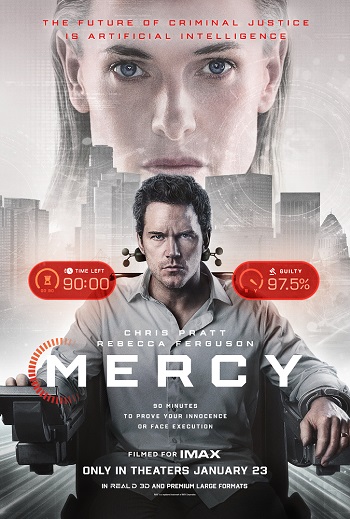
MERCY (2026)
Starring Chris Pratt, Rebecca Ferguson, Kali Reis, Annabelle Wallis, Chris Sullivan, Kylie Rogers, Kenneth Choi, Rafi Gavron, Jeff Pierre, Tom Rezvan, Jamie McBride, Ross Gosla, Mark Daneri, Haydn Dalton, Michael C. Mahon, Noah Fearnley, Carlos Antonio, Brittany Black, John Bubniak, George Cambio, Stephen Corliss, Mick Gallagher, Charlene May and Renata Ribeiro.
Screenplay by Marco van Belle.
Directed by Timur Bekmambetov.
Distributed by Amazon MGM Studios. 100 minutes. Rated PG-13.
Sometimes a film is a lot of fun, until you start to think about it even the least bit critically. Suddenly, whatever stupid fun you may have been having totally evaporates. Like, this simply makes no sense and absolutely could not happen. Never. Never ever.
Have Mercy. Please.
If the storyline of Mercy sounds familiar – hero cop in the near future is put on trial for his life for a crime he insists that he did not commit and acting as judge, jury and executioner is an emotionless supercomputer – it is because the same basic storyline was done much better in 2002 with Steven Spielberg’s Minority Report starring Tom Cruise.
Of course, Steven Spielberg is a far superior filmmaker than Mercy director Timur Bekmanbetov. And even though Tom Cruise was on the early downslide of his acting career by the time Minority Report was made, he was still much better than Chris Pratt is here.
This is not to say that Chris Pratt cannot act – check out his old work in Parks and Recreation – but he has spent so much of the past decade or so trying to be a blockbuster action hero that his character acting has little nuance or humanity left in the tank. At this point he has just a couple of dramatic modes – angry-but-heroic and tortured – and while he does those well, it makes for a very flawed hero. How is the audience supposed to show empathy for his apparently unfair circumstances if his character is so hard to warm up to?
And that whole “near future” proviso…. The storyline of Mercy starts a mere three years in the future (2029), making the hard-to-buy-anyway changes in technology, world events and simple procedures of law nearly impossible to believe. I get that AI is making changes in leaps and bounds that are stunning, but there is no way that the world will change so profoundly in a matter of a few years. Just on a basic storytelling front, had they simply changed the narrative to make it take place maybe 20-30 years in the future, it would be much easier to buy into what Mercy is trying to sell.
It also doesn’t help that the storyline is so predictable that you fully know who the bad guy (or bad guys) will be halfway into the narrative, even though they are presented as upstanding and supportive friends or colleagues of the accused. Of course, the fact that at least one of them has a motive which is highly coincidental at best, far-fetched at worst, does not help things either.
Most of Mercy is set in one huge room, where the supercop is held on trial for the killing of his wife by an AI judge – played with suitable stiffness by Rebecca Ferguson. The trial is portrayed as a high-tech affair where details of the crime are quickly revealed with free-floating apps, search engines, Facetime calls and apparent full access to every surveillance camera and cell phone in the Los Angeles area.
Honestly, it’s a hyperactive form of filming which is sometimes cool but more often distracting. This annoying factor is particularly noticeable in a scene where an explosion is witnessed on a cell phone feed, and it appears that the whole courtroom is a raging inferno. While that may be somewhat cool visually, it makes no narrative or even technological sense.
Also, the ability to find any piece of evidence on demand at the click of an app makes Mercy feel like a bit of a cheat as a mystery, which despite all the high-tech bells and whistles and hyperactive action sequences, the film is essentially supposed to be. And the rationing out of that evidence – for example a sound not heard on a camera recording the first time we see it, but later heard on that very same recording, or the possible outline of a face in a brief shot of a darkened staircase – just gives the feeling that the evidence is being parceled out selectively for narrative purposes only.
By the time that the plot devolves into a frantic high-speed chase through the streets of LA – watched in an immersive Cinerama shot which places the courtroom right in the middle of the action – Mercy has lost any sense of realism at all. Hell, at one point a police car loses control and drives over an inexplicable ramp on the side of an LA street. That old trick hasn’t been used since the glory days of Hal Needham. I’m shocked that the car didn’t drive through a fruit stand.
You may even buy into it if you shut off your head. There are enough fun action sequences that you may feel rewarded for just surrendering to Mercy. But if you give Mercy even cursory thought, it collapses like a house of cards.
Jay S. Jacobs
Copyright ©2026 PopEntertainment.com. All rights reserved. Posted: January 22, 2026.
 PopEntertainmentblog.com