Rose Byrne
Gives a Career-Elevating Performance, Gaining Awards and an Oscar Nomination As A Troubled Therapist Dealing with Trauma
by Brad Balfour
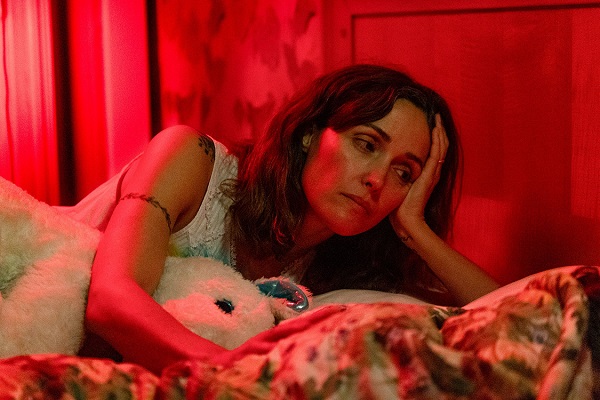
In If I had Legs, I’d Kick You, Australian actor Rose Byrne’s presence is extraordinary. The 46-year-old possesses energy that drives a performance traversing between the real and the surreal, full of physicality and emotion. This career-defining role has been garnering her praise, awards and Oscar nomination talk.
The film had its world premiere at the 2025 Sundance Film Festival in January 2025. At the 75th Berlin International Film Festival, Byrne won the Silver Bear for Best Leading Performance. Later in the year, she won the Best Actress award at the 58th Sitges Film Festival for the same role.
It received a domestic release by A24 in October and got positive reviews. Byrne’s performance received universal acclaim and nominations for a Golden Globe Award and Critics’ Choice Award for Best Actress.
Written and directed by Mary Bronstein, the film stars Byrne, Conan O’Brien, Danielle Macdonald, Christian Slater and A$AP Rocky. Byrne, as Linda, plays a therapist stretched to her limits while caring for her daughter, who is suffering from a pediatric disorder. The daughter must be fed through a PEG tube each night, and her demands add to Linda’s immense stress.
Renowned for her versatility across film and television, Byrne has been recognized for her leading roles in blockbuster comedies, independent dramas, and horror films. Her previous accolades include two AACTA Awards, a Silver Bear and a Volpi Cup, in addition to nominations for two Primetime Emmy Awards and three Golden Globe Awards.
Byrne’s performance as this troubled mother has again put a spotlight on her. She spoke at a recent screening where, answering questions from a moderator, she offered insight into the challenges she grappled with in playing such a complex part.
You spent a lot of time with director Mary Bronstein before the shoot to discuss the screenplay, explore the character, and rehearse. Talk about that process.
Absolutely. Mary and I had a period of about five weeks when I went to her apartment in Chelsea. I’d dropped my kids off at school or camp. It was over the holidays [so] we worked three days a week and sat at her kitchen table. We went through the script from page one, word one, and would talk, go off topic, and share our own horror stories. The story of Linda, or the experience she’s going through, is based on something Mary Bronstein went through in her life.
Obviously, she doesn’t act like Linda, but it’s an expression of something she’s spoken about quite openly, so it was like comparing her to a play. It was very rare. We shot the film in 27 days, so it was quick with some ambitious sequences in the film. Everything is practical. There’s a tiny bit of CGI on her stomach, but that’s it. Everything else, [including] the hamster.
I don’t remember the hamster.
Well, the hamster in the screenplay is described as [being like] Jack Nicholson from The Shining. It’s much stricter than that. When I read that bit, I was like, “Oh, that’s fabulous.” I was laughing a lot. The humor you see in the film is very much reflected in what I read. The screenplay was truly the same expression in a way I’ve never experienced before as an actress, so I was quite blown away when I read it.
This film’s very personal to the director. How did you insert your own interpretation? You have made this film your own, and it’s hard to imagine anyone else playing this role.
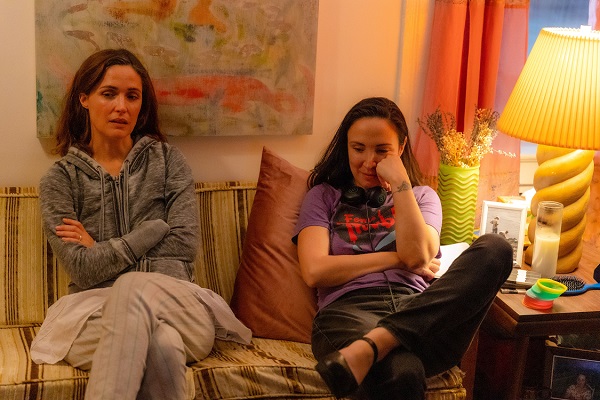
There is, of course, a sense of responsibility, and it’s such a heavy story. It’s a personal crisis and this is Mary’s story, so it’s open back to her. But at a certain point, you have to jump off. Once you’re on set, it becomes something else. Mary was very collaborative. It was never, mine, mine, mine. It’s ours from day one. It was like, “We’re collaborating on this, we have a creative dialogue,” and I brought my questions to the table.
My obsession was, who was this character before we met her? Because there’s no information you can remember. Who was she before this crisis? Like, she was a person, and she used not to be a mother or a wife. Who is she? Can we reverse engineer? That’s the actor’s homework. You don’t see that written all over, because it’s boring, but you want it to feel lived in. That’s what we talked about a lot, she and I.
You appear in pretty much every single scene; the camera is on you relentlessly. There’s nowhere for the character – and also for you, the actor – to escape or to hide. What was it like to be so exposed?
It was the tensest technical assignment in many ways. It stretched me, technically, in ways I’ve not experienced before. I did a television show where I put it all together after I had to look at the map box for a long time. I’ve done some more sophisticated camera work that was the language of the camera, but this was really pushing it to the extremes. The first day was the hardest, because [that’s when] we shot the first scene in the film. That’s always stressful anyway.
You’re anxious, you’re establishing so much, you get to know everybody. I was working with Mary, the director, who plays Dr. Spring, and the camera just got closer and closer and closer. I could hear it going, “drr, drr, drr, drr, drr, drr” so this shot was like on 35 (indecipherable) and she was like, “mm-hmm, mm-hmm, okay.” I didn’t ask again after that. I just … it’s my job to figure it out. But it stretched me and changed me, the experience of working like that. Because what they need, and also what they don’t need, is more of a question when you’re that close. So it was a challenge, but it was fun, Yeah.
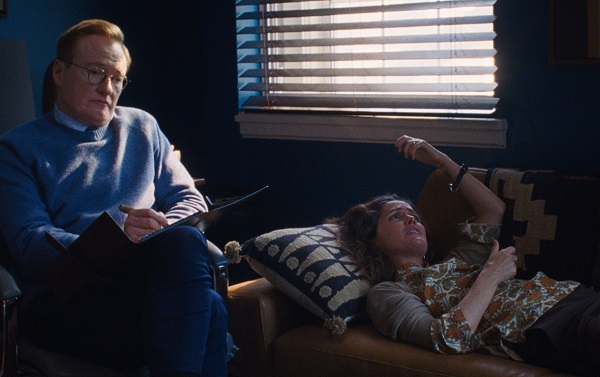
You and Conan O’Brien have incredible chemistry on screen.
I’m a bad therapist right there.
You both bring sharp comedic instincts to this film. What’s really fascinating is that there’s nothing inherently funny about those therapy sessions, or even the conversations where your character shares some of her darkest thoughts during therapy. She talks about how she got rid of the wrong child, and she’s not supposed to be a mother. Talk about juxtaposing comedy with the darkest and most painful human experiences?
It’s a great question. That’s something I’m interested in in life. I think there’s always a tragic balance every day, waking up and being a person. This film rides a tightrope of that, the whole way, of too much … of the trap of something that is one note. It’s just a hysterical woman and there’s no nuance.
The other way [to see it] is that it’s too comical, that it has no weight and is silly. It was the fine tightrope we were trying [to walk] – the tone that Mary had written and was trying to go for in the scenes. And obviously Conan is a national treasure, and so funny. But he was very strict about it. He was very much playing somebody entirely the opposite of him, playing this gregarious man who is also a reserved person with a lot of boundaries who was very strict.
You might really see the relationship between the therapist and the mirror as the love story of the film. It’s the bitter end of the relationship, where they just have contempt for one another, and they’re both misbehaving. Then when he doesn’t actually break up with her, the film ends, but that’s the end of it. Ten minutes later she’s running into the ocean. She has no guardrails after that, but his intelligence shines through in his performance. He was very nervous too; he tried to get out of doing it.
He’s really good.
He’s an awesome actor. Mary really wanted to think outside the box for the casting, she didn’t want to do the more typical, expected casting for the role. At the same time, he shot that before he shot the Spike Lee movie, so I think it was his first or second acting job, yeah.
When you were reading this screenplay, did it occur to you that it was also a comedy and not just a dramatic film about a woman’s breakdown?
It did occur to me. I can see the humor. When you’re reading the script and when it’s revealed that she’s a therapist, I thought that can’t be true. Then when I go back, she’s walking down the hall and is kind of indifferent. I was like, “Oh my.” I thought that was such a joke.
To me it’s such a reveal: you put therapists on this pedestal, and it’s such an isolated experience. You have them – you don’t know anything about them – and then, one of my favorite moments is when they see each other in the little kitchenette. It’s so awkward. It’s that moment, right, where you’re just like, “mm-hmm.” It’s that weird, awkward thing when you see someone out of context, but I felt the script throughout.
Mary describes it well – that the film lives between the worst thing that’s ever happened to you in your life, and the worst thing that’s happened to you today. It’s sort of between those two worlds, because of these grievances that Linda came up with. Whether it’s the parking attendant, or the gentleman that isn’t fixing her roof, or the hamster, or these grievances day-to-day that become monumental.
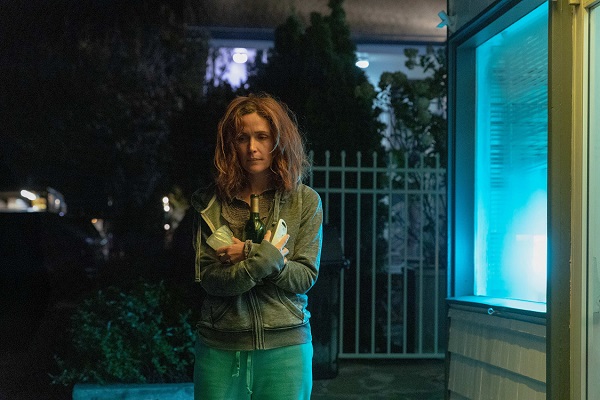
There are two women who are suffering in this film, two mothers – you and Danielle Macdonald. She’s great in the film, playing your patient, Caroline. She’s also in the middle of a crisis, for similar reasons, but not exactly the same. The film portrays the two characters very differently, giving nuances to depression and mental breakdown. Despite your character’s circumstances, she provides her patient with care and even gives her advice. How did you, Danielle and Mary, discuss the portrayals of these two mothers?
That’s a great question, Danielle [MacDonald] was brilliant. She actually came into the film later and had very difficult scenes. She has spoken about this. She spoke to friends who had suffered from postpartum [depression] and were going through that sort of thing. Mary and I also talked to a therapist along with many women who had suffered from postpartum [depression] … women with children with special needs.
We did research in that world too, but I think how Mary presents it in the film is very interesting. There’s also a bit where Linda is looking in the computer about Andrea Yates – that horrible case of a woman who killed her kids. She’s looking at real footage of Andrea. Then shortly after that, Caroline, her patient, leaves the baby and runs off.
I think when you zoom out, it feels a bit like her patient didn’t get the help she needed, because Linda was experiencing burnout, and couldn’t really help this woman. Linda’s not getting the help she needs, as a mother who’s not quite coping, because her therapist isn’t giving her the right advice. It seems like these women are being short-changed, and they eventually just become something you click on, like they didn’t get the help they needed.
Why would Andrea Yates just become another item that you click on? And that feels like when Caroline runs away, she’s going to become that next article you read about. We never saw her again – did something horrible happen? So if that makes sense, it feels like there’s a thought about the lack of help that women need in these postpartum phases, or a mother in crisis in a situation like that.
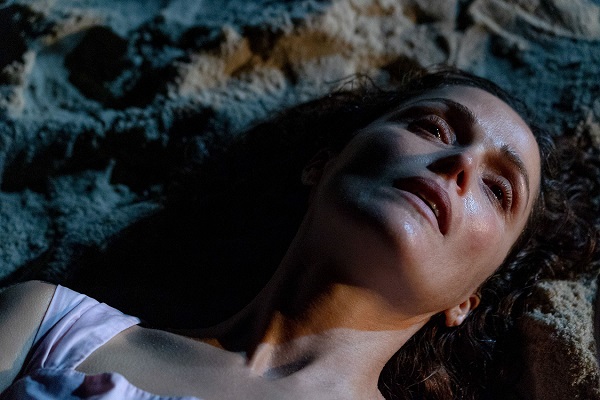
There are many scary moments in this film, and the scariest is when the character repeatedly runs toward the waves on the beach. That moment really centers her. Talk about the making of that scene, and also what it meant to you at that moment?
The scene was one of the hardest sequences to build; it was an extremely rough ocean at night. The cinematographer went out at one point, and I had to go get him. Then Mary was like, “Did you see that?” She was checking if I’d seen it or not. I’m from Australia, so I have a lot of respect for the ocean. You grow up very young swimming. 87% of the population is on the coast, so basically you learn to swim as soon as you’re born. That helped me in a sense. I knew when to say I needed help, but I also knew when I didn’t want to go either. I knew how to get in and how to get out. It was really scary, it was rough. I think the scene is actually extraordinary when you see it.
When I saw that sequence put together, it was very moving. It feels to me, again, like she’s trying to escape. With the whole film, she’s trying to escape. I think she’s trying to escape herself, like her biggest demon is her trauma inside. It’s that thing inside that we all are trying to escape from. I feel like the ocean literally spits her back out and says “No, you’re not going to escape.” I feel that seeing the daughter’s face at the end, to me, feels wonderful. She does finally say, “I’ll do better, I promise.”
Then you end with a child, and a child is hope, you know? You see her face and you haven’t seen this face the whole film. That’s in the screenplay, that she says you never see the daughter’s face. Mary’s spoken to this as well, but it’s a two-pronged thing that she describes. As soon as you put a child on the screen, your empathy will go with the child, as it should. So she took that away from the audience, just with the mother. Also, I think, Linda can’t see the child at that point. She’s just become a caretaker. She’s not even really a mother anymore. She’s not enjoying being … there’s no joy there at this point. So it feels like, to me, the film ends with some hope.
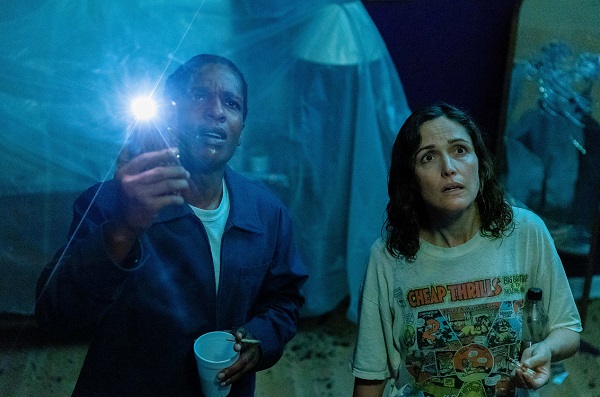
That it feels like it’s a hopeful moment, but I don’t believe everything can be resolved so easily.
It’s been so interesting how the film plays … it’s kind of a magic trick. I’ve had some audience members go, was A$AP Rocky real? Was he just in your imagination? Some people think that he’s not real, or Danielle’s character’s not real. I can’t lie: it’s fascinating. It plays like a horror [film]. At the New York Film Festival, it plays very much like a comedy. People were laughing straight away. It was a very sophisticated crowd. In Toronto, it was more like a college crowd, so it played more like a horror film. It’s been fun to see that.
This film will forever be a super highlight in your bio. It has taken you to all different extremes. Did you discover something new in yourself as an actor? And what are the new challenges you want to take in the future?
I think it has changed me, creatively. I’m stretched to my limit of everything, and it was a great role in that sense. I don’t know if I met all of those challenges in every moment, in every scene, but I certainly gave 1000 percent. Every day after work, I’d be like, “Did I do this?” I was very obsessed with it and found it hard, the separation anxiety from Mary Bronstein after every day. And going through everything in my head. But it has changed me. I’m not sure what I’ll do next. With something like this, that’s this extreme, you have to kind of breathe out. I can’t anticipate what will be even close to this.
Copyright ©2026 PopEntertainment.com. All rights reserved. Posted: March 10, 2026.
Photos ©2025 by Logan White. Courtesy of A24. All rights reserved.
 PopEntertainmentblog.com