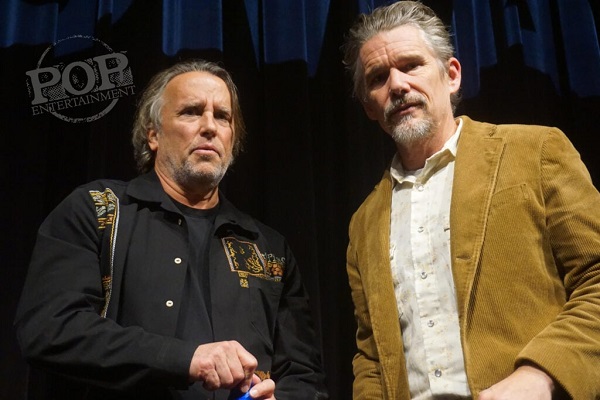
Ethan Hawke and Richard Linklater
Blue Moon Documents The Night Lyricist Lorenz Hart Realizes His Partnership with Richard Rodgers is Over
By Brad Balfour
Inspired by the letters of legendary lyricist Lorenz Hart and Elizabeth Weiland, director Richard Linklater developed the biographical drama Blue Moon with a script written by Robert Kaplow. It stars veteran actor Ethan Hawke playing the diminutive Hart in his waning days before his untimely death at 48.
Linklater and Hawke have worked together before – in the film Boyhood where it won significant notice and for the Before trilogy which also garnered award noms as well. After debuting at The New York Film Festival this Fall, the film is getting further attention and has led to various nominations for Hawke, including the Oscar nom for Best Actor.
Born Lorenz Milton Hart, the American lyricist was half of Rodgers and Hart – the legendary Broadway songwriting team. Some of his more famous lyrics include those for such standards as “Blue Moon,” “The Lady Is a Tramp,” “Manhattan,” “Bewitched, Bothered and Bewildered” and “My Funny Valentine” among many others.
Hart was born on May 2, 1895, in New York’s Harlem, to German-Jewish immigrant parents, Max M. and Frieda (Isenberg) Hart. Through his mother, he was a great-grandnephew of the German poet Heinrich Heine. (The elder of two sons, his brother, Teddy Hart, also went into theater and became a musical comedy star.)
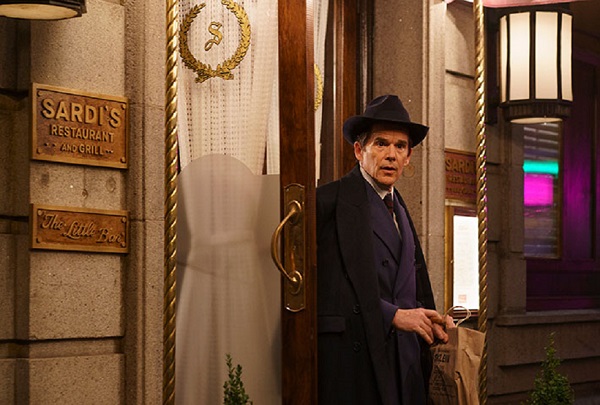
On March 31, 1943, Hart slipped away from the opening night of Oklahoma! – the new hit Broadway musical his former creative partner Richard Rodgers (Andrew Scott) had written with Oscar Hammerstein II. Hart arrived at Sardi’s restaurant, where preparations were underway for the opening night celebration.
The film follows Hart as he reflects on himself, his failed partnership with Rodgers, his obsession with 20-year-old beauty, Weiland (Margaret Qualley), and delusional hopes for the future. A few months later, the masterful writer was found dead on the streets.
In June 2024, Sony Pictures Classics acquired its worldwide distribution rights in addition to joining the project as co-financier. Principal photography took place over 15 days on a soundstage in Dublin, Ireland, wrapping by September. Now this film, celebrating the music of another era, is being celebrated as well with star Hawke and director Linklater enjoying various accolades and positive reviews.
The following conversation is an edited version of a discussion that took place after a screening at the Museum of Modern Art as part of their Contenders series.
Have you ever seen the musical Oklahoma! on stage?
Ethan Hawke: No. My first musical was a little-known one called Annie that I saw in Atlanta. I went home and immediately wrote a sequel to it called Arthur. You remember how she had a little half heart? Well, the truth is, she had a twin brother. He also had red hair and lived in a boy’s orphanage. He had the other half.
So what happens at the start of my musical is she’s on the fire escape, and sings, “maybe far away,” but the other boy was like, “or maybe real nearby.” Her parents taught them that song to reunite them. It was the story of their reuniting. It was very sad.
Richard Linklater: It felt like Oklahoma! as well as all the music of Hammerstein, were just there in my whole life. My mom was listening to the cast recordings, so the music was there. I saw it somewhere along the way. I saw it numerous times, but it was in schools.
You not only made Blue Moon and Nouvelle Vague, out this year, but you’ve also produced 200 movies, have five in production at least, including a film adaptation of Stephen Sondheim and George Forrest’s Merrily, We Roll Along.
Richard Linklater: Five in production? Not that I know of. I think things get listed online, throw out an idea.
Ethan, you have two films in release right now. In addition to Blue Moon, you have Black Phone 2 out, and a multi-episode television series, The Lowdown. You’re also executive producer of a podcast series Fish Priests and you’re making films of your own.
Ethan Hawke: We do work a lot.
How do you juggle all of these projects?
Richard Linklater: We haven’t worked together in 10 years. We figured out we have a big gap. But that’s my answer.
How do these films and projects inform each other? How do you shift roles because you’re obviously adept enough to do that. Is it just the way that you’re thinking about certain projects at a specific moment in your world?
Richard Linklater: This had a long gestation. We’ve been on this for like 13 years, we figure, somewhere in there. Also, that’s the same for Nouvelle Vague, the French New Wave film. Ethan has made films, documentaries, and narratives about artists. You could put them together. I think you had seven films.
Ethan Hawke: The two of us both like to work. Maybe it’s part of our friendship. We both are restless and really enjoy it. One of the things I love about Rick is how curious he is, that you could be in love with punk rock and Rogers and Hart. That you can make a baseball movie and a movie about Jean-Luc Godard. His interests are comprehensive; really one of the most wonderful things about us being friends is how curious you are about all different walks of life. It informs your movies. We both are really restless, I think.
Richard Linklater: Yeah, and we meet without any ideas. Like, it’ll be, “what are you reading? When are you coming? Hey, I read this thing on Tumblr.” We’ve just always been like that. Ethan and I met in 1993, fall of ’93, 32 years ago. We started talking then and we’ve been talking ever since. We’ve made movies along the way, too, a lot. We didn’t even realize it had been 10 years, because not only are we developing this, but there’s also other things we’re talking about. It’s just ongoing.
Ethan Hawke: We just got the script for this while we were finishing Boyhood. That’s how long we’ve been talking about this.
Richard Linklater: … We’ve been talking about this thing.
One of the films that comes to mind is the collaboration you did on tape, which was an adaptation of a play. I think it was a chamber piece, set in real time, in a motel. It does have a certain kind of affinity for this single-location film.
Richard Linklater: Sorry, this is a more fun location than a crummy motel. It’s nice to be here. But, yeah, that was a real time movie in one location. So, I think that informed this. We’ve been talking about that a few times here.
Ethan Hawke: The Before Trilogy has an aspect of real time to it as well. There’s a lot. Rick likes to say that if you don’t have a plot, you need to make it very concise.
Richard Linklater: I think that’s a fact. People mentioned it in something else.
Interestingly, you were not the first to play Larry Hart, Mickey Rooney came before you.
Ethan Hawke: Mickey Rooney and I play a lot of the same parts.
Did you watch the film Words and Music? It’s a take on their lives [released in 1948].
Ethan Hawke: It’s pretty silly.
Richard Linklater: Yes, that’s an excuse to have it, in 35 mm with some really nice performances. It’s silly, of course.
It’s a heartbreaking story, really. When you read this book about Hart, A Ship Without A Sail: The Life of Lorenz Hart, his final months are just absolutely devastating. The question everyone, of course, has been throwing out in the context of this film is the physicality of this performance and the transformations you have to go through for it.
Richard Linklater: Everybody gives actors a lot of credit when they put on a lot of weight or lose a lot of weight, but no one ever gives them credit for losing a lot of height.
Ethan Hawke: I’m proud of myself about it. The history of cinema has spent a lot of energy making small, diminutive men look large and powerful, and we just had to invert it. But it was his physical appearance that says a lot about his relationship to himself and to society. It was an important aspect to the character. He’s the smallest person in the room with the biggest personality, and I’d like to think that it almost felt like if he stopped talking nobody would see him, That’s how he felt. We knew it was important, and how to do it was extremely tricky.
We knew we didn’t want to use computers or anything like that, but that wasn’t the only thing. It’s the dyed hair and the comb-over. He has arthritis. And he’s going to die in a few months. But in truth, those superficial things are only valuable if they’re unlocking his soul in some way. If the movie became about that, it would be to his detriment. We were trying to look for things that would unlock him, and unlock me as an actor, to become somebody else.
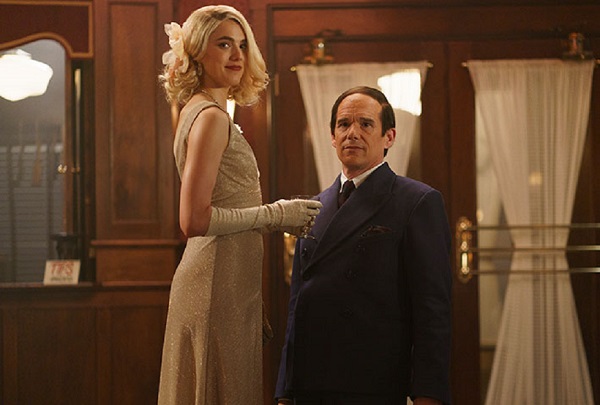
Richard Linklater: I had a front row seat for that unlocking, and when you were five feet tall looking up at everybody, you’d be like, “Holy shit, it’s a whole different world.”
Ethan Hawke: None of my attempts to flirt with Margaret Qualley went over with anything but a ridiculous nickel.
Richard Linklater: Technically, it was a real pain in the ass, of course, but the actor who played Oscar [Hammerstein], who’s notoriously a tall guy, was probably, Ethan’s around six feet tall, that guy was like five nine. Elevating him – but he was perfect for Oscar – so we would have him up on some boxes, and Ethan kind of lower, and everybody trying not to fall in, trickle in.
It was a good capture. It was said that Larry Hart didn’t even think he was capable of seducing his own shadow, which is beautiful and heartbreaking.
Richard Linklater: That was a big leap for Ethan to be able to get to that headspace. No, never, never has anyone ever wanted to do it that way.
Ethan Hawke: All that’s funny, but the truth is, from the get-go, this is a screenplay that I spent 40 years of acting. On the one hand, I can count the amount of screenplays that knocked me back so much that I was like, I have to do this. The quality of the writing, learning the lines was fun, because I would sit there and giggle and be moved. Every turn of phrase was fascinating and so well-built.
The way it really does function, the whole movie, and we came to this pretty early in the process. Years ago, when we first started reading it out loud, we said, the whole movie needs to feel like a 90-minute Rodgers and Hart song. It’s got to float. It’s got to have a bridge. It’s got to have dissonance and resolve and have that same wit and the same soulfulness that they carry. If we could do that, then we felt like we could sustain the audience’s attention with this period. The target of this movie is so small. It’s such a fragile film, and Robert’s writing is so exceptional. It would be impossible without it.
Seven Minutes in Heaven in the Coat Room is one thing, but when the quality of writing is so high, it makes it thrilling for us. Then our job became about how to make sure we believed it, and how to make the song take off.
When you’re playing real-life figures, are there ground rules for what you feel comfortable doing or not doing? I’m not talking about historical figures like Marco Polo, or Jesus, or Joan of Arc. I’m talking about people in recent memory. Do you do copious research? Do you try to emulate mannerisms, like the famous hand rubbing that Larry Hart would do in nervousness?
Ethan Hawke: Well, you say famous, but most people haven’t heard of Larry Hart.
Richard Linklater: Even going to the height. First off, no one even knows who Larry Hart is, much less how tall he is. It matters to us. It matters to that character. So we try to be as exact as possible. There’s footage of him. They shot a lot of short promotional bits with Rogers. So you can see him walking around.
Ethan Hawke: He’s kind of an awkward guy at his height.
Richard Linklater: Yeah, a lot of photos, he’s a pretty handsome guy. He would always position himself kind of up, and Rogers would be sitting. But you see him walking around. It’s like, he isn’t awkward. He’s awkward in his body, for sure.
Ethan Hawke: I felt a sense of relief that I had all the benefits of these specific details about the real man to draw from, create dynamics in the movie, without the albatross of… if you play Johnny Cash or Muhammad Ali, or some of these more famous figures where the audience has a huge backlog of expectations about what the person looks and sounds like. I didn’t have to deal with that, so I could choose what would help me in this performance, and help Robert’s writing, and help Rick.
You’re more inclined to be John Brown or Nikolai Tesla or Larry Hart than taking on Muhammad Ali anytime soon, but you never know.
Ethan Hawke: It frees you up as an actor. It’s more exciting. If you were to play JFK or something like that, everybody has such awareness of how he moved and looked, and you start having to do an imitation, and then that would scare me.
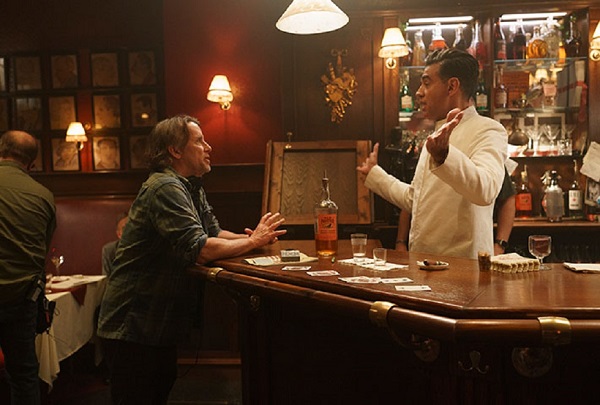
One of the things that is very poignant about this film is that it marks the passing of a moment in New York life. It is very moving to see Sardi’s, for example, a place that doesn’t exist like that anymore.
Ethan Hawke: It still exists. It’s funny you say that, because Bobby [Cannavale, who plays the bartender in Blue Moon] and I shot [at] a little Sardi’s [set] in Ireland, and Bobby and I were like, “Before we get in the plane, let’s go to [the real] Sardi’s. Let’s break bread in Sardi’s and just try to bring New York with us.” We sat down there, and there was Patti LuPone sitting there, having a martini and talking. It’s different. Broadway is so different. Broadway used to be the absolute fulcrum of the entertainment world. Everything started here. The power of it has been diminished, and the romance of it has been diminished, but there’s still the likes of Broadway showing up.
Richard Linklater: I feel the ghost there. I’ve been doing old theaters. They’re still here.
So many of your films, though, are about these kinds of inflection points in history, whether it’s the life of an adolescent, or it’s the life of a city.
Richard Linklater: This works on a couple levels, I think. In Broadway history it’s kind of a before and after moment, in musical theater history. But I always thought, well, gosh, it’s just the end of an era. But it’s really from Larry’s perspective, like, the way it’s moving on without him, that was so poignant. I always thought this thing was like this sad little howl into the night from the artist who’s being left behind. Specifically by his partner, who’s moved on. But the times, too, even more, kind of crushingly, at his taste and what he’s about is becoming a thing of the past. So I don’t think any artists think of what they do as having an expiration date or taste changing, but it does. It evolves, particularly in music, where it’s just the idea that something was ending. He was aware enough to feel it.
Nouvelle Vague, it’s obviously a turning point in filmmaking. The young Turks of the Cahiers thumbed their noses at the ’40s and ’50s generation of French filmmakers. there is a tense sense of the passing of the baton, in a way.
Richard Linklater: With that one, it’s out with the old in a good way, for sure. It’s like independent-spirited movies. You need these new ways. You need punk rock moments where things get reinvigorated. In musical theater, it changes, but people still argue, is that good? You know Oklahoma! Even in films, when The Sound of Music came out, Hitchcock famously said, “Oh, shit, this thing moves movies back about 20 years,” when that became a huge hit.
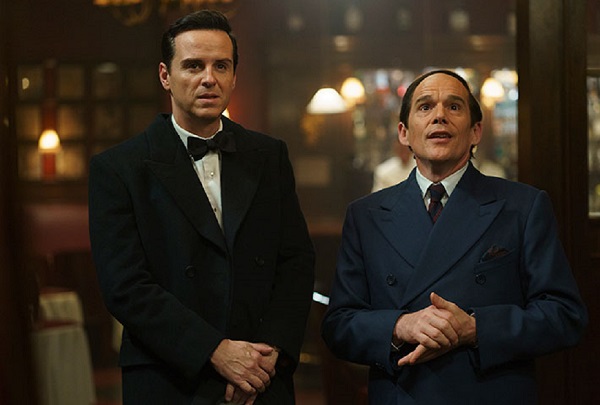
Richard Rodgers is not a villain by any stretch. He was driven up the wall by Larry. He did everything he could to encourage Larry to work on Oklahoma! to say nothing of Connecticut Yankee. But the performance is also really moving, because you get the sense he’s driven up the wall, but at the same time, he knows that Larry’s days are numbered.
Richard Linklater: I think that is what’s heartbreaking about it, that he’s not coming. He’s done everything. He’s probably hung on another 10 years past and was getting exasperated with Larry’s drinking behavior. But it is heartbreaking to see that coming to him, really just because of Larry’s problems. I told Andrew, “It’s like, don’t worry, I’m Rodgers. I’ve had a couple of people who just have problems, and you have to do it for the team.”
It’s painful to be in that position. You can see it on his face. There’s love there. There’s a triumph over the relationship. There’s all that respect for his talent. It’s sad to see it coming to an end. Not really even for artistic reasons, but just personal reasons like that. But that’s how life is. People have problems, and they can’t outrun their demons quite often.
Given how long this project was gestating, did you talk to Stephen Sondheim about it?
Richard Linklater: I just missed it. There’s another just brief quote from him in this book, he was often calling Hart sloppy in the way he wrote the lyrics and the way they landed on the music. It’s hard to imagine. Only somebody like Sondheim could even perceive such a thing.
It’s unimaginable.
Richard Linklater: His loyalty is so clearly Oscar’s talent. When you talk about Rodgers to people anywhere near a music theater, it’s like, “okay, Hart or Hammerstein?” And everyone says Hart, except one person. Because [Hammerstein] was like his uncle, like his dad. [Sondheim] just had to carry the torch for him.
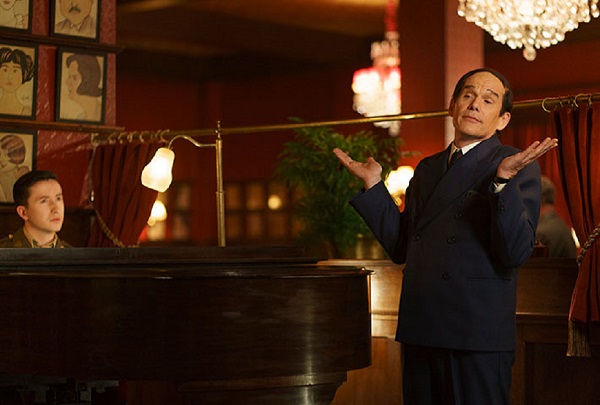
He did say Hammerstein pointed out something to him, which at the tender age of 14, he didn’t fully comprehend. That Larry Hart freed American lyrics from the stilted Middle European operetta technique into a natural form of speech.
Richard Linklater: We paraphrase that in the movie.
You can really appreciate the absolute connection between Hart’s songwriting, his lyrics and Sondheim’s.
Richard Linklater: Oh, absolutely. It’s fun too. [Becoming] the greatest lyricist ever from having been in a conversation just for a bit. That is something, that’s the kind of leap we would take, Robert took with the screenplay. It’s like young Sondheim didn’t say that; old Sondheim said that. But he said it. it’s just funny to throw that in Larry’s face.
How conscious were you of marrying certain kinds of implicit lyrics to the action on the scenes? Or even just the way that they are like your delivery of lines, which is so rapid-fire and so unceasing. How do you marry the dialogue to the sensuousness of the music at the time?
Richard Linklater: That was so fun to have a piano, just a happy soundtrack going. To work it where he mentions Gershwin, or he’ll say a line, and then the piano can kick in something that’s related. Or he starts playing from Casablanca, and he realizes. That was so fun. I just picked all my favorite songs that could possibly be played on the piano that night. It’s obviously not just Gershwin’s part. It’s everything.
It’s everything you perform while you’re delivering lines. Sometimes.
Richard Linklater: A lot of it. But one of those grand moments, my friend, also a composer, he played. We went to the studio; he did over 100 songs. Then you can kind of sprinkle them throughout. That was so fun to work in, to get a soundtrack.
Ethan Hawke: The whole movie is 90-minute raptures in our song. That’s what we’re trying to do. The filmmaking is Rodgers applying the structure, skeleton, and musculature of the movie, and my job was to sprinkle these lyrics on top. I think that’s a brilliant job.
Copyright ©2026 PopEntertainment.com. All rights reserved. Posted: March 11, 2026.
Photo 1 ©2025 by Brad Balfour.
All other photos ©2025. Courtesy of Sony Pictures Classics. All rights reserved.
 PopEntertainmentblog.com