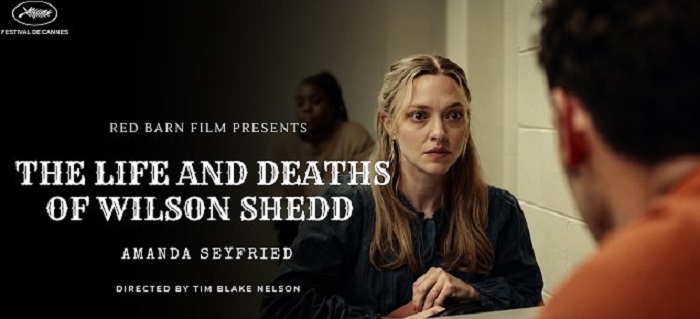
THE LIFE AND DEATHS OF WILSON SHEDD (2026)
Starring Amanda Seyfried, Scoot McNairy, Missi Pyle, William Jackson Harper, Elizabeth Marvel, Grant Harvey, Devyn Tyler, Wunmi Mosaku, Benjamin Brown, Tim Blake Nelson, Tobias Segal, Robert Peters, Kraig Dane, David Aaron Baker, Xuri Selah, Chloë Kerwin, Josh Henry, Terence Rosemore, Eric Blount, Gary Baker, Shifali Baliga and Randy Barco.
Screenplay by Tim Blake Nelson.
Directed by Tim Blake Nelson.
Distributed by Red Barn Films. 121 minutes. Not Rated.
Screened at the 2026 Philadelphia Film Festival.
The Life and Deaths of Wilson Shedd tells a based-on-a-true-story tale that is extremely timely right now, one of a mass-murderer who is due to be executed for his crimes. The film explores many of the issues of modern executions and the fact that drug companies refusing to sell execution drugs often leads to botched, painful deaths.
However, death-row prisoner Shedd (Scoot McNairy) is not the main thrust of the film, nor is he the most complicated character. That is Karen (Amanda Seyfried), a very unhappily married teacher who is desperate for work and takes a job teaching creative writing at a local prison.
Most of the convicts don’t seem to take the writing overly seriously, but Shedd turns out to be a rather natural writer; honest, self-aware, brutally confessional. His writing intrigues the dissatisfied teacher, to the point that she becomes unreasonably wrapped up in her student. His writing becomes friendly, then flirtatious, and finally outright declaring feelings.
Whether he is manipulating her or really cares for her is up for debate. The film seems to feel that Karen’s emotional rawness and need for any sense of love or purpose may have made her more susceptible to Shedd. I suspect my feelings on the subject may vary from those of writer/director/actor Tim Blake Nelson, although even he acknowledges in the screenplay that Shedd’s behavior may be mere manipulation.
Karen starts sharing Wilson’s secrets and eventually puts herself and others in danger by slipping him contraband and helping him plan his escape from prison.
Sometimes you just have to go for a storyline or not. While The Life and Deaths of Wilson Shedd is extremely well-made, smartly cast and takes on many serious issues, overall I could never really get into it.
The biggest problem is the character of Karen. Granted she has a horrific, mentally and physically abusive home life. Her husband is a massive asshole. And perhaps she is not used to being paid attention to. But how exactly is she going to make that better by helping a murderer – even one she has inexplicably developed feelings for – escape from prison and going on the lam with him?
The film flips back and forth in time, and of course the fallout from her acts – shown in glimpses throughout – seem both tragic and entirely avoidable. Shedd’s first story in her class – a horrific tale of a boy hunting a squirrel for supper with a shotgun – should have been a massive red flag for Karen.
You can say that The Life and Deaths of Wilson Shedd is inspired by real events and that you can’t hold the truth against the film. Fair enough, I’m not saying that Wilson Shedd isn’t a realistic story, or one that does not have some truly thoughtful views on crime and punishment. I’m just saying that it was a story that I’m not sure I wanted to see told, even if I do agree with much of what the film is trying to say.
The Life and Deaths of Wilson Shedd is far from the first story in which someone from the outside falls in love with a convict. I keep remembering George Costanza’s line in an episode of Seinfeld, that the only thing hotter than conjugal sex is fugitive sex. But that was a comedy, and it was about a white-collar prisoner.
I know it happens, but every time I see one of these stories, I think what the hell is the matter with her (or him) to fall for someone they know for a fact is a violent felon?
Which is a shame, because it is when the film turns a jaded eye towards capital punishment that Nelson’s passion for the subject emerges and the movie truly works. These parts of the film are reminiscent of Dead Man Walking – although not quite as good as that film, which is no huge crime.
The Life and Deaths of Wilson Shedd would be a better film if it were actually about Wilson Shedd rather than Karen. Shedd may be a complicated, often reprehensible character, but his story is much deeper and more intriguing than that of Karen.
That is not a knock on Seyfried, who sells the character with more conviction than she may deserve. But even when they are on screen together, McNairy’s quietly hostile character commands attention in ways that Karen’s pathetic, lost victim character simply doesn’t. At least we can understand his apparent motivations, which McNairy sells with understated malevolence.
Perhaps the most surprising acting job comes from an unusual place. Missi Pyle, who tends to overact in broadly comic films, has some truly heartfelt moments as the compassionate warden who has overseen too many executions. Writer-director Nelson took a rather unshowy small role as an empathetic prison administrator.
Nelson wisely kept his role small and let other actors do the heavy lifting while he concentrated on the filmmaking side of the equation. His film is crisp and evocatively directed, even if I only about halfway bought into what he was selling.
Much like its title character, The Life and Deaths of Wilson Shedd is a complicated mixture of conflicting qualities; surprisingly smart and soulful, but with good intentions which often go horribly awry.
Jay S. Jacobs
Copyright ©2026 PopEntertainment.com. All rights reserved. Posted: October 22, 2026.

