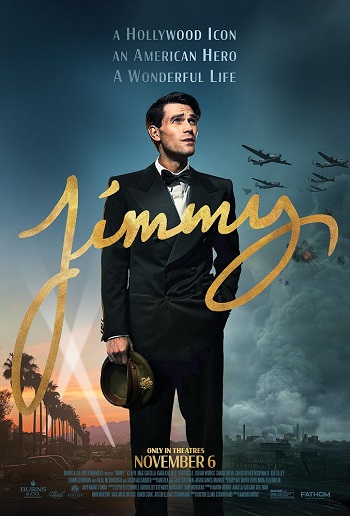
JIMMY (2026)
Starring KJ Apa, Max Casella, Kara Killmer, Rob Riggle, Julian Works, Sarah Drew, Christopher McDonald, Jen Lilley, Jemma Donovan, Neal McDonough, Jason Alexander, Courtney D’Angelo, Louis Furney, Karolyn Grimes, Liam Bixby, Marc Malkin, Jean Law, Daniel Fee, Larsen Thompson, Michael James Ford, Conor Thornton and Aidan Thornton.
Screenplay by Justin Strawhand.
Directed by Aaron Burns.
Distributed by Fathom Entertainment. 120 minutes. Rated PG-13.
Jimmy Stewart was a man who lived a fascinating life. He grew up in a small town in Pennsylvania. He moved to California to get into the film biz. He was a movie star for decades – most of his adult life. He went to war, even though he could have gotten out of it as a film star. He became a war hero just a few years after winning an Oscar. He was a small-town boy and an aw-shucks guy who just happened to hobnob with some of the biggest names in show business. He made more classic films than most actors have even seen. He had several interesting flirtations before a long-lived and happy marriage.
He deserves a good biopic about his life. Maybe someday we’ll get it. But for now we have Jimmy.
It’s interesting that the filmmakers felt comfortable naming their film simply Jimmy, because they seem to believe that most modern moviegoers know him only for one performance, if they know him at all. They may even be right. With many of his classic films over 50 years old, the younger generation may not know all of the hit films that Jimmy Stewart made during his career. They probably also won’t know that the film they do know him from was not one of those hits.
But for film buffs like me, by pretty much sticking to about six or seven years in his life, Jimmy overlooks much more about Jimmy Stewart’s life than it explores.
Nearly three-quarters of Jimmy is about Stewart’s time in the Army Air Force – and yes that is a very important and notable part of his life. However, it really sells his acting career short. The only film that is even discussed in Jimmy is It’s a Wonderful Life. (Although, they did nod towards his Oscar-winning performance in The Philadelphia Story, but never referred to the film by name, just noting that he won. A couple of titles are also divulged in the historic stills shown over the end credits.)
I get it; It’s a Wonderful Life is probably his best remembered performance today. And it was the first film he made after returning from war. But let’s not pretend that It’s a Wonderful Life is something it wasn’t. It was a commercial disappointment when it was released, and never really found an audience until three decades later. It only became a holiday standard after the film’s copyright lapse made it inexpensive for television stations to air repeatedly during the holiday season. By the time it became a cult favorite, Stewart was already in his 70s and largely retired from acting. When it became a cultural institution, Stewart was already dead.
Still, it seems like malpractice to only discuss one film in a biopic about an actor whose career lasted over 50 years and 80 movies. His filmography also includes such classics as You Can’t Take It with You (1938), Mr. Smith Goes to Washington (1939), The Shop Around the Corner (1940), The Philadelphia Story (1940), Rope (1948), Harvey (1950), Rear Window (1954), The Man Who Knew Too Much (1956), Vertigo (1958), Anatomy of a Murder (1959), The Man Who Shot Liberty Valance (1962) and many more. Not a single one is mentioned, even though every one of those was much more highly regarded during Stewart’s career.
In his life Stewart made a point of rarely discussing his time at war – in honor of his fellow soldiers who didn’t make it. So, basing so much of the story of his life on something which he did not personally want to discuss feels at odds with the way that Stewart saw his own legacy. When even the scenes on the filming of It’s a Wonderful Life often focus on Stewart’s PTSD from combat, the film feels like the makers of Jimmy believe that its hero was defined by his service and that his much longer-lived career as an actor is of secondary importance.
By allowing one chapter of his life to define the whole man, Jimmy shortchanges the actor, his fans, and the people who are just discovering him. It is a part of the man – arguably a big part of the man – but it is not the only part of the man.
The film’s focus on Stewart’s military service might be easier to accept if the wartime footage felt a bit more authentic. The many war scenes shown in the film were created by AI rather than done with more organic special effects. It gives the battle footage – and even just the straight flight footage and many background shots – a bit of an unrealistic feel. It’s hard to get too worked up over an aerial dogfight when it looks like something out of a video game.
Then again, Jimmy is trying so hard to turn Stewart into a legend that it forgets that Stewart’s defining quality was that he was an everyman. This film is a bit of narrative building in a life that simply didn’t need it. To indulge in Jimmy’s preoccupation with It’s a Wonderful Life, the movie is trying to sell us on the idea that Stewart was Harry Bailey rather than George Bailey.
Take KJ Apa, who plays Stewart here. He actually looks a bit like the real man (although he is definitely shorter than the notoriously gangly Stewart) and he has mostly captured Stewart’s distinctive cadence and mannerisms. But he spends so much time channeling Stewart’s more dramatic moments that he seems to forget that the man was not always “on.” Not every moment in his life was “Dear Father in heaven… I’m not a praying man… but if you’re up there, and you can hear me… show me the way…”
Sometimes he was just a relaxed guy enjoying his life. During the end credits they show a quick clip of the real Stewart on the piano with Dean Martin on Martin’s TV show, just two guys telling stories and singing an old song together. Jimmy needs more of that playful Stewart.
The other performances, much like the film itself, tend toward the mannered and old-fashioned, in some cases going more than a little bit over the top. (I normally love Jason Alexander, but he plays Louis Mayer as if he stumbled in from a road-company of City of Angels.) The one exception is Christopher McDonald, who brings warmth and wisdom to a brief cameo as Lionel Barrymore. However, the fact that the best acting job in Jimmy is done by someone on screen for about two minutes is not a good sign.
Another nice cameo moment comes from an appearance by Karolyn Grimes – who had played George Bailey’s young daughter Zuzu in It’s a Wonderful Life – which gives the film a nice sense of history it doesn’t always earn.
Harry Bailey famously gave a toast to his brother in the climax of It’s a Wonderful Life, referring to Stewart’s character as “the richest man in town.” Sadly, Jimmy hasn’t quite figured out what made the man so rich.
Jay S. Jacobs
Copyright ©2026 PopEntertainment.com. All rights reserved. Posted: November 6, 2026.

