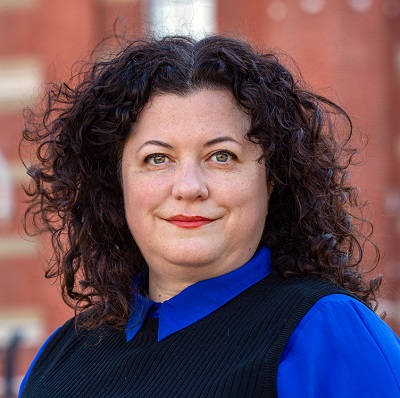
Katie Camosy
Is Not Going to Be Gaslit
by Jay S. Jacobs
“They paved paradise and put up a parking lot.” Those classic Joni Mitchell lyrics seem almost wistfully idealistic when considering just six decades later, industries have encroached upon small communities, overrunning them and poisoning the air, contaminating the water, endangering public health, ecosystems, and wildlife for corporate profit.
Exposing this industrial creep and the harm it does has been a longtime passion of filmmaker Katie Camosy, who has been making short films for the environmental advocacy agency Greenpeace for years. Now she and Greenpeace have put together her first feature-length exploration of the problems becoming endemic in the southern United States.
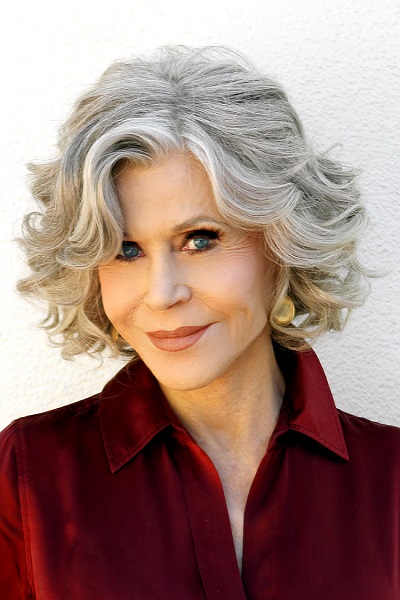
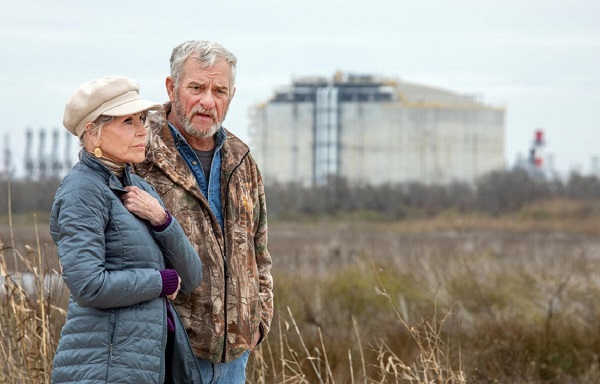
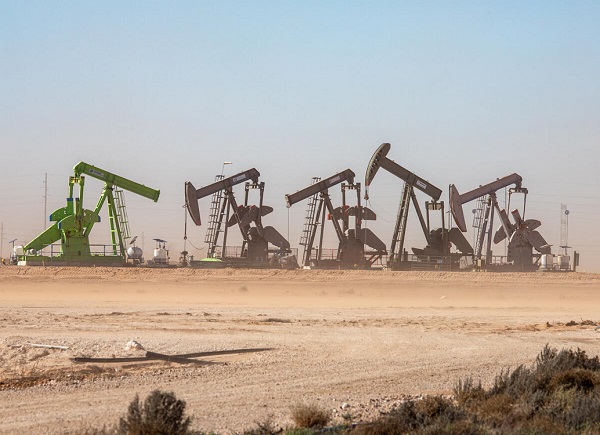
Director Camosy got together with screen icon and longtime activist Jane Fonda for a road trip through the Texas Oil Fields and the Gulf Coast states to survey the damage on local communities done by the oil and gas extraction boom. As explained in the film’s press kit, these changes “have led to the United States becoming the world’s biggest liquefied ‘natural’ gas (LNG) exporter and a massive expansion of plastics production, as fossil fuel companies double down on petrochemicals to secure their future.”
Camosy and Fonda – together with brief visits from friends, actress Connie Britton and singer Maggie Rogers – toured oil country learning firsthand how the massive expansion of corporate presence in local municipalities has destroyed local life, bringing pollution, illness, and environmental degradation to many southern communities. They spoke with local shrimpers, cattle ranchers, former oil workers, faith communities, community organizers, self-described “reluctant activists” and got a firsthand look at just how catastrophic these changes have been.
Gaslit recently won the Best Documentary prizes at both The Santa Barbara International Film Festival and Raindance Film Festival. It is currently available for streaming on Documentary+ and on Prime Video.
Just a matter of days after the US midterm elections, which brought a wave of political change to the country, we caught up with Katie Camosy to discuss Gaslit and the possibilities of change.
Katie, you’ve spent years documenting environmental issues for Greenpeace. At what point did you decide that you wanted to make this into a feature film rather than, I believe, you’d done shorts previously?
That’s exactly right. It all started when Jane Fonda – who I’ve been working with through Greenpeace – and I went down to the Gulf to a place called Port Arthur, Texas. It’s right on the border between Texas and Louisiana. That’s where we first saw these big gas terminals, these LNG [Liquefied natural gas] terminals. It all started there. But just like you said, at first, we thought maybe this would be a web series, [or] maybe we do these as shorts. What I really wanted to communicate is that it isn’t just about one city, one region, one community, or even one type of industry or company. We really have a systemic issue with the polluting oil and gas industry in this country, and so much of it is concentrated along the Gulf Coast. I’d say the big swing we took was instead of following one person or a few people, you’ll meet about 20 people in the film: shrimpers, ranchers, community organizers, and we got them all in there. We used Jane Fonda as the tour guide to keep us understanding where we’re at.
Jane serves both as a participant in the film and as a guide. What did she bring to the project that another narrator or host couldn’t have?
Jane is the real deal about all this work. (laughs) She’s been working on climate issues for a long time and has been an activist for a lot longer. She was there [for] pre-production. She brought notes to the shoot. She was there watching cuts in the edit room. Very involved. On top of her commitment to these issues and understanding and curiosity, she has an ability to connect with people. I was really amazed to see it. She spent just about a month with us in the Gulf and it didn’t matter your political persuasions. She was talking to not just Democrats, but Republicans, some MAGA folks. But she can really listen and connect with them on their level. I just saw people open up emotionally in ways that they didn’t when she wasn’t there. Just a really great partner.
Jane is obviously a celebrity. How important was it for you with her – and also with Connie Britton and Maggie Rogers – that they fit right in with the normal people that you were interviewing?
They play a few roles. Of course, by having celebrities in your film, you get more attention when the film comes out. You get in front of some new audiences. That’s one very practical piece about it. Also, I see them as serving as audience avatars. The audience probably doesn’t know as much about these issues as the people living and working in the Gulf who are fighting these issues, trying to protect their communities. They’re really the focus. These celebrities come in and they ask a lot of the same questions that the audience might have, and they learn from it that way. Jane particularly gives information as we need it as we go along. But Jane and everyone were very clear that the focus of the film needs to be on the people in Texas and Louisiana. I’m proud that’s what we ended up with.
How did you find out about the everyday people working to help their communities that appear in the film, and what did you learn from them?
We met most of them through Greenpeace. You’ll see a lot of Greenpeace archival footage. They’ve been in the Gulf on and off for 30 years at least, and a lot of those relationships have been held. So once I knew that I wanted to gather more information, I had a great wealth from our researchers and our campaigners and all of that. Then also once we got to the Gulf, we kept hearing about more people, because this isn’t just affecting certain folks. It’s so systemic down there. We shot over 500 hours of footage. (laughs) We shot a lot. Two hours make it in, but we’re going to be using this footage for years to come. We just did so much documentation of this moment in time.
In the press kit for the film, you said that when you started working with Greenpeace, first thing they told you was, “We lose. A lot.” How important is it to you to keep fighting, even with just getting incremental gains?
That’s the whole ball game, right? When the environmental movement wins, it wins big. We can see that with the smog issues that used to happen in this country. I remember Lake Erie being on fire. You can still see photos of that. The whole ozone layer. There are so many wins. I think we could do better about the wins, but also it takes a lot of people a lot of time to make those changes. There’s a lot of despair out there, and I get it. I get it, especially if you look globally at what needs to be done. There’s a lot that needs to be done. What I hope people see from the film is there’s so many ways that you can take action. You can work really locally. That matters. That makes a difference. Some of the people in the film are doing direct action. They’re doing a hunger strike, which gets them a meeting with the company, which is amazing. That stuff does work. But you don’t have to do that. You can use the law. You can talk to people in your faith and religious communities. You can do citizen science. There are so many ways to plug into this, and I think it all starts with looking at your community. What industry is here? What industry is coming here? Is it a data center? Then talking to your neighbors and getting information.
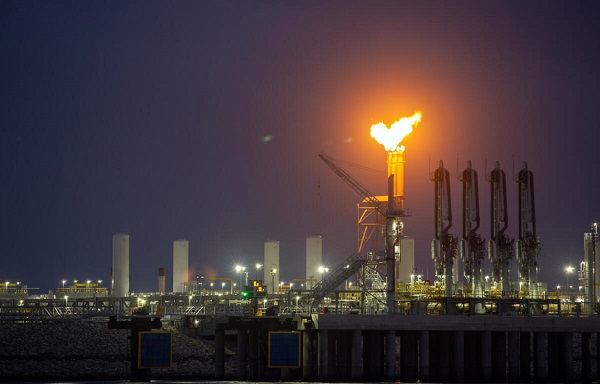
You write that environmental pollution is often invisible, and that science can be intimidating. How do you make those subjects cinematic but not oversimplify them at the same time?
I’ve run across that a lot working on these issues for years. The way we did it in the film is I wanted the people who live and work in this area to be the main storytellers and the focus. We’ve learned so many times that facts don’t necessarily change people’s minds. If you can empathize with someone and hear their experience, and relate to them, that [gets to] a different part of your brain. [That’s] what we did in the film because there’s wonky terminology. There’s LNG. There’s fracking. Not everyone understands that. So we use animation. We have beautiful illustrations in the film that will tell it to you quickly and give you the information that you need to know, so we can get back to the lived experiences and the storytelling. We also use Jane in the voiceover for that at times as well. Yeah, it’s a lot of information. But I think mostly you’re going to be hearing stories from people from all walks of life that you might not meet every day.
I know that pollution and climate are not specifically political issues, but how do you think that this week’s elections might have an effect on some of the problems that you’re discussing?
I am cautiously optimistic, Jay. (laughs) Both Republicans and Democrats take money from the oil and gas industry. That’s something we want to stop. But the Republicans are the ones with the “drill, baby, drill,” so I think by getting in a lot of Democrats, we have a real opportunity for community members to be listened to. In Texas specifically, where half the film takes place. In the film, you hear Elida Castillo, an organizer there, talk about Governor Abbott and how hard it is to put regulations on these industries in Texas. With a new governor there, there’s a lot of opportunities to change the way they do business.
Your subjects came from diverse backgrounds and political persuasions. What did you find that they had most in common once you spent some time with them?
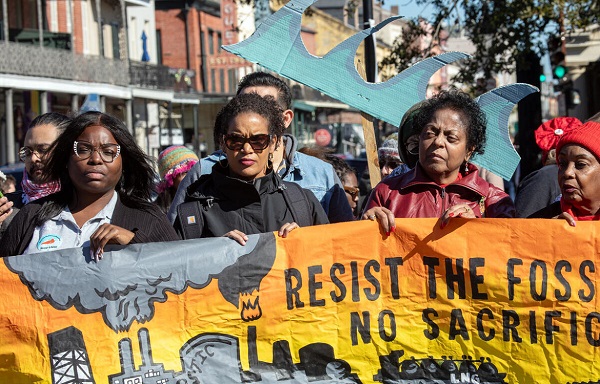
It was a real love for the people and place where they lived. Many of them were there for generations, and they care so much about it. They all come at it from a different place, but what they all agree on is that this oil and gas pollution is way too much, and it’s way too close to where people live and work. We had air pollution, water pollution, and soil contamination. We also had them displacing entire communities, building infrastructure where the fishing docks were in Louisiana, a place that really cares about their shrimpers. This way of life that had been there for generations was being decimated, and they felt that the people in the communities weren’t being heard and weren’t being listened to.
Did you find common ground in places that you wouldn’t have expected?
I really get excited when you meet these unlikely allies who might not agree on a lot but can agree on this. We’re showing up with Greenpeace and with Jane Fonda, and you do wonder like are we going to be seen as othered? I’m not from this region. I’m coming in like the audience is really fresh, but what I found is that the people there are not really thinking about that when their community is under threat. When their children are sick with asthma. When they’ve got high rates of cancer. Different kinds of diseases that they attribute to the industry there. When it becomes life and death, like how are we going to put food on the table? How are we going to stay safe and healthy? They just want to work with people who are looking for solutions. We saw that time and time again. Those left and right issues dropped away. I think we’re seeing that with data centers too. Data centers aren’t that politicized yet. It is people on both sides who are questioning it. That gives me a lot of hope.
This is your first feature film after making short films. How was the process different in doing a feature, and what did you learn from this experience?
Well, it’s all longer, right? (laughs) We went back to the Gulf maybe seven or eight times over about a year and a half. We went to Germany. What I really loved about the long format is that you can go in deeper. When you’re making social media videos, especially if you’re trying to get them down to the one-minute mark, you stay away from the acronyms, from the wonky science. I have to say, sometimes you stay away from the nuance. I really loved having more space to do that. There’s a man in the film, John Allaire, who used to work in the oil and gas industry, all different levels of it. His issue is mostly with the fact that we’re exporting gas to other countries, including countries that we have an adversarial relationship with. That’s the kind of perspective that would be hard to get into a 60-second video about these issues. But I think it’s such a relevant point. He talks about the anger of seeing energy, heating costs go up here in the states. Grocery costs go up, which is all related to this as well. What I saw in that is that I don’t think we should be afraid of nuance. We should show different perspectives, even if they don’t exactly align in every single way with our talking points or our perspective. I hope that we just see more and more docs taking on thorny issues and looking into it that way.
Your career began documenting the London music scene and eventually made it into climate documentaries. Looking back, are there any storytelling lessons that you took from your music projects that still influence your work today?
Yeah, oh, that was quite a time. There I also had the instinct of going for many, many, many people, and then figuring out the narrative afterwards. I do like these collective stories where you get a whole bunch of people talking. One thing I did learn, back then I was trying to do a lot more of this myself, and so I’d say what I’ve learned in the meantime is you need a great crew. My crew was incredible. My editor Laura Franco-Velasco went through those 500 hours with me. Josh Gibson, our cinematographer, told me at one point during the shoot that this was the most important project he’d ever worked on. So, finding a crew who doesn’t just see it as a job but really cares about the people and locations, that really makes all the difference.
After spending years documenting these issues, what still gives you hope?
This election gives me hope. The fact that people are still fighting and finding these different ways. We see a lot of archival footage in there, and what seems to be different now from let’s say 30 years ago is that these groups across Texas and Louisiana, and further than that, are more connected now than ever. This movement is working together, strategizing together. I do think that people are really looking to understand what’s happening and find solutions for it. With data centers being less political, I think that’s a real way to talk to people about industry coming in, using water, having emissions, noise, running on fossil fuels. There are so many connections to it. I’m really encouraged that people are questioning it and not necessarily believing the promises that these companies make.
What do you hope that audiences will take from Gaslit and think about, not just as they finish, but as they move forward in their lives?
After watching Gaslit, I hope people think I might not live somewhere that looks as dramatically industrialized as the places in the film, but maybe I should look around at my neighborhood and talk to people in my community about it. People have a lot of power, even against these billion-dollar industries. If you can organize, get the information, get people on the same page, you can hold the companies already there to account, and you can keep out companies, industry, and pollution that you don’t want.
You say that the story doesn’t have a neat, happy ending because it’s not over yet. If you revisit these communities in five years from now, what do you hope, or think, you’re most likely to see?
If I were to visit them in five years, and I’m sure that I will, I hope that I’m seeing that the movement’s grown larger. Because even though we met so many people who cared about these issues, over and over again they said that there were neighbors that they just couldn’t get on board. Not even that they disagreed, but that they just wouldn’t spend their time on it. That they either thought it was hopeless or that they couldn’t make a difference. What I hope to see is more of what we saw down there, but growing, and that the local leaders are listening to their constituents.
Copyright ©2026 PopEntertainment.com. All rights reserved. Posted: November 6, 2026.
Photos ©2026 by Tim Aubry and James Franklin. Courtesy of Greenpeace USA. All rights reserved.

