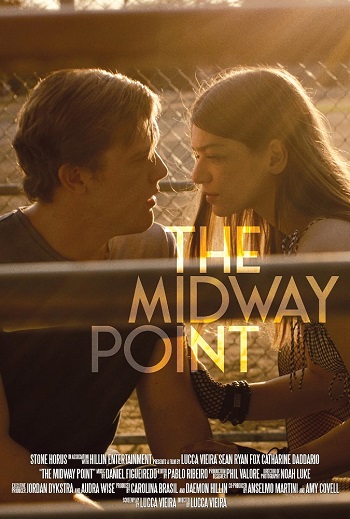
THE MIDWAY POINT (2024)
Starring Sean Ryan Fox, Catharine Daddario, Thora Birch, Wes Studi, Julie Benz, McKay Clark, Fernanda Fernandez, Ariadna Gutiérrez-Arévalo, Grace Jones, Seth Lee, Julia Llamas, Natalia Nikolaeva, Ashley Puzemis, Jessica Sherman, Kholan Studi, Christopher Veluz, Audra Wise, Nicholas Solis and Madeleine Lemay.
Screenplay by Lucca Vieira.
Directed by Lucca Vieira.
Distributed by Level 33 Entertainment. 87 minutes. Not Rated.
Some films arrive with the best of intentions, and The Midway Point is one of them – a coming‑of‑age drama that wants to explore neurodivergence, emotional isolation, and the combustible friendships that can form in the pressure cooker of adolescence. But good intentions only get you halfway there, and fittingly, that’s exactly where this film seems to stall.
The story follows Jake (Sean Ryan Fox), a teen on the autism spectrum – though the film treats that detail more like a footnote than a foundation. Fox gives a gentle, sympathetic performance, but the script rarely lets him inhabit the specificity of Jake’s inner world. Instead, he’s framed as a generically shy kid who occasionally mentions being different, as if the movie is afraid to lean into the very perspective that makes him unique.
Where The Midway Point finds its most authentic moments is in the adults who orbit Jake’s life – the ones who see him not as a plot device, but as a kid trying to navigate a world that overwhelms him.
Thora Birch, as Jake’s mother, gives the film its emotional anchor. She plays the role with a weary tenderness – a woman who loves her son fiercely but is exhausted by the constant fear of failing him. Birch never overplays the frustration or the protectiveness; she lets it simmer. In her scenes, the movie suddenly feels lived‑in, textured, real.
Wes Studi, as Jake’s math teacher, brings a quiet, steady presence that the film desperately needs more of. Studi has a gift for grounding a scene with a single look, and here he becomes one of the few adults who recognize Jake’s intelligence rather than his limitations. He doesn’t coddle him, doesn’t condescend – he simply treats Jake as capable. In a movie where many characters talk at Jake, Studi is one of the few who talks to him.
Julie Benz, as Jake’s art teacher, provides the film’s warmest notes. She plays the role with a gentle, encouraging energy – not saccharine, not patronizing, just genuinely invested. Her classroom becomes one of the only spaces where Jake feels safe enough to express himself, and Benz gives those moments a quiet authenticity the film could have used more of.
Then there’s the kind of love interest, Catharine Daddario’s Alice, a character who feels like she was assembled from three different screenplays. She’s alternately the wild‑child party girl, the wounded teen acting out, and the emotional catalyst who pushes Jake toward growth. Any one of these versions could work. All three at once makes her feel less like a person and more like a narrative device with mood swings. Daddario commits to the role, but the writing never gives her a consistent emotional throughline. Her interest in Jake feels abrupt, her volatility unmoored, her motivations murky.
Director Lucca Vieira clearly wants to make something personal – a story about connection, miscommunication, and the fragile bridges we build between people who don’t quite fit anywhere. After all, the writer/director is only about five years older than his high school characters and apparently has experienced life on the spectrum. There are moments when the film brushes up against something honest: a hallway conversation that almost lands, a moment of vulnerability that feels unforced, a look from Birch that says more than the dialogue ever does.
But too often, the film retreats into familiar teen‑movie beats – the party scenes, the social media cruelty, the “will he or won’t he step up” arc – and the specificity drains away. The movie wants to be raw, but it’s hesitant. It wants to be intimate, but it keeps defaulting to trope.
By the end, you’re left with a film that has its heart in the right place but can’t quite articulate what it wants to say. Jake and Alice should feel like two lost souls colliding at exactly the right moment. Instead, they feel like characters who never fully made it out of the conceptual stage.
Ironically, it’s the adults – Birch, Studi, Benz – who bring the depth and grounding the teen storyline keeps reaching for. They’re the ones who make the world feel real.
There’s a better movie inside The Midway Point. It just never quite finds its way past its own title.
Alex Diamond
Copyright ©2026 PopEntertainment.com. All rights reserved. Posted: May 19, 2026.
 PopEntertainmentblog.com