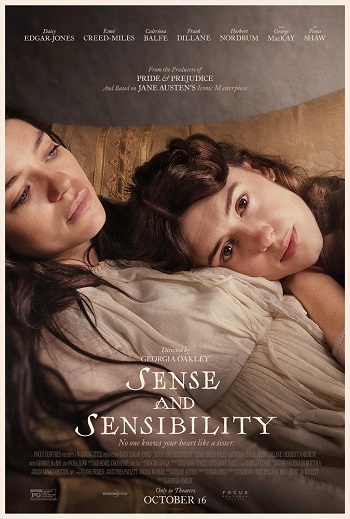
SENSE AND SENSIBILITY (2026)
Starring Daisy Edgar-Jones, Esmé Creed-Miles, Caitríona Balfe, Frank Dillane, Herbert Nordrum, George MacKay, Fiona Shaw, Bodhi Rae Breathnach, Stacy Martin, Tom Brooke, Turlough Convery, Bethany Slater, Eliot Sumner, Chloe Pirrie, James Carcaterra, Charlie Varlet, Paulie Bovingdon, Thea Beyleveld and Ceara Coveney.
Screenplay by Diana Reid.
Directed by Georgia Oakley.
Distributed by Focus Features. 132 minutes. Rated PG.
In a modern world where most movies pivot on hyperactive violence, gratuitous bloodshed, horrific misbehavior and blatant sexuality, it is nice to go back to a place of Sense and Sensibility. It is a Jane Austen world that is perfectly civilized and comfortably slow-moving. It is a place where politeness and honor are virtues, where families and friends support each other and where love is something pined for in silence for years. It is a place where the most scandalous gestures are kissing, dancing and drinking, where grand balls and parties in huge manors are major events and the gravest mayhem is a duel in which neither party actually gets shot.
What’s the old saying? I may not want to live there, but it sure is a nice place to visit.
There is a reason why 215 years after the release of Austen’s novel it is still beloved when so many of its contemporaries are long forgotten. Sense and Sensibility is a time capsule to a long-gone location of repressed civility, a universe bearing very little resemblance to our modern-day chaos of division, anger, rampant sexuality, spite, class-warfare and MAGA hats.
There is also a reason why Hollywood keeps going back to this story – to the point where there have been at least six official film or television adaptations of the book. These date back to the first live-for-television version in 1950 starring a very young Cloris Leachman – with several others loosely (or not so loosely) based upon the source material. Of the previous adaptations, the most acclaimed version was the 1995 take with Emma Thompson, Kate Winslet, Hugh Grant, and Alan Rickman, which won an Academy Award for Best Adapted Screenplay.
The new version of Sense and Sensibility is earthier, more serious and more restrained than that glibly charming period piece, and yet it offers many of the same delights as its predecessor.
At the same time, it is very faithful to its time period and the mores of the era. It does not try to shoehorn modern sensibilities and sexuality into its plot – like, say, last year’s adaptation of Wuthering Heights, which I did enjoy, but took liberties with the source material that probably had Emily Brontë rolling in her grave.
Jane Austen, on the other hand, would probably be rather comfortable with what this version has done to her story. (Other than, perhaps, being a little freaked out by the simple idea of a moving picture.)
Sense and Sensibility revolves around The Dashwood family – in particular the two oldest daughters Elinor (Daisy Edgar-Jones) and Marianne (Esmé Creed-Miles). When their father dies, by the laws of the time, the family manor was entailed to male heirs – and since he had only daughters in his second marriage, it passed to his son from a previous marriage.
Thus his second wife and three daughters are thrust out to a much smaller home with little money to survive. Mrs. Dashwood (Caitríona Balfe) does her best to care for their three daughters, but she knows the best way for her daughters to thrive is for them to find a man to care for them. (In this world, for better or for worse, the only opportunities available to women revolved around finding a good husband.)
Youngest daughter Margaret (Bodhi Rae Breathnach) was too young to marry, but Elinor and Marianne were right at courting age. However, they were both in their ways romantics – although Elinor was a bit more refined in her dealings with men, Marianne was freer with her desires – and they both wanted to marry for love as well as money. In fact, all things being equal, love was the most important thing for both.
As pretty young women, not surprisingly men were quick to notice them. Elinor caught the eye of Edward Ferrars (George MacKay), a humble but honorable local man. The problem was, to save the honor of another single woman who he had no feelings for, Ferrars agreed to eventually wed her, and now he felt it was his chivalrous duty to honor his word. However, he quietly pined for Elinor, and the feeling was mutual. But since Elinor shared his sense of honor, she also refused to stand in the way of Ferrars’ potential marriage. Neither would admit their true feelings to each other.
In the meantime, Marianne caught the attention of two suitors. First there was Colonel Brandon (Herbert Nordrum), a quiet and guarded military man who found it very difficult to share his feelings. Therefore, he stood aside stolidly as Marianne became involved with John Willoughby (Frank Dillane), a charming and boisterous heir, who Colonel Brandon knew was also more than a bit of a cad.
So both sisters find themselves in very early versions of love triangles, each of which lingers over a period of many months, as they pine away for the man of their dreams. Of course, neither relationship works out quite as they expect. I won’t say how they end up – even for a 215-year-old story, there are still people for whom that may be a spoiler – but I think you can make a pretty safe bet on what happens yourself.
Of course, Sense and Sensibility is a grand story that is not just about two girls’ love lives. It also takes a pleasing look at high and low society in the Regency period, focusing on family and friends and life in Sussex, Devonshire and London in the 1790s. It is full of verdant, green fields, bustling streets and huge luxurious galas, all captured by the atmospheric lens of French cinematographer Arnaud Potier and in the evocative language of Diana Reid’s screenplay and Georgia Oakley’s sympathetic direction.
The acting is terrific, with most of the actors feeling period appropriate. Particularly good is Creed-Miles, who captures Marianne’s outgoing, passionate and slightly naïve nature. Edgar-Jones is more controlled and repressed as sister Elinor, which is fitting for the character. As far as the other family members go, Breathnach brings joyful youthful energy to youngest sister Margaret. Balfe as the mom is tragically worried for her girls, but a loving matriarch. Fiona Shaw steals nearly every scene she is in as their ribald, gossipy and high-spirited widow Mrs. Jennings who takes the Dashwood women into her home and also tries to help with their romantic entanglements.
The suitors all show their positives and their negatives as potential life partners. As Ferrars and Colonel Brandon, MacKay and Nordrum both show deep discomfort with the idea of opening up their hearts, and yet they do also convey the true courtly passion they feel for the sisters. And Dillane captures the charming but thoughtless wooing of Willoughby.
There is a reason that Austen’s work still resonates more than two centuries after her death – because for all the ways the world has dramatically changed, the simple truth is that people mostly have not. We just want to love and be loved. Sense and Sensibility takes us back to that most elemental state of being, and for two hours it is nice to be transported back to a time when that was still embraced.
Jay S. Jacobs
Copyright ©2026 PopEntertainment.com. All rights reserved. Posted: October 16, 2026.

