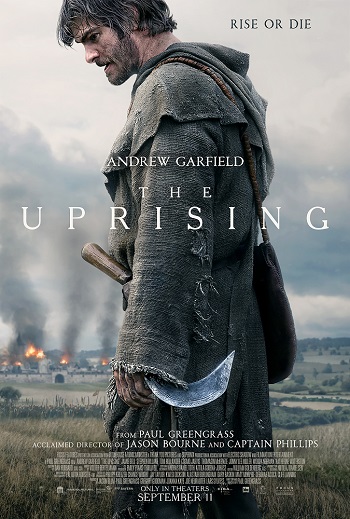
THE UPRISING (2026)
Starring Andrew Garfield, Jamie Bell, Stephen Dillane, Tom Hollander, Cosmo Jarvis, Thomasin McKenzie, Jonny Lee Miller, Woody Norman, Katherine Waterston, Sky Yang, Dónal Finn, Stanley Townsend, Jamie Maclachlan, Brechtelsbauer Andreas, Liebischer Angelika, Tobias Bachfischer, Sam Chapman, Michael Dominik Gronau, Patrick Haderer and Robin Jäger.
Screenplay by Paul Greengrass.
Directed by Paul Greengrass.
Distributed by Focus Features. 128 minutes. Rated R.
The Uprising has been the subject of one of the more puzzling marketing disputes of this movie summer. Suddenly, a couple of weeks before the release, out of the blue the American distributor dropped the little nugget that this is a film about the rise of Robin Hood. The British distributor has flatly denied that, saying it is a historical film about the Peasants’ Revolt of 1381.
So which is it – a historical film, or one based upon British folklore?
It certainly resembles none of our cultural touchstones for Robin Hood – no Sherwood Forest, no Sheriff of Nottingham, no merry men, no Friar Tuck, no stealing from the rich and giving to the poor, no men in tights. Bows and arrows only show up in the last half hour, and even then, they are mostly (but not exclusively) used by the King’s men. The go-to weapon in The Uprising is mostly swords, although our hero is partial to a sickle.
Also, the legend of Robin Hood is supposed to take place in the late 12th century – around the 1190s – so how can a character from that era be inspired by a social movement that took place nearly 200 years later?
And if it isn’t about Robin Hood, then why suddenly tie your film to that old, often‑told legend mere months after The Death of Robin Hood appeared in – and disappeared from – cinemas in the blink of an eye?
Now, I’ll admit, it’s been years since I was fluent in the legend of Robin Hood, so maybe there were some huge Easter eggs in The Uprising pointing to the old tales as their source, but I didn’t catch them. There is no clue in the main character’s name because he is only referred to throughout (even by himself) as Ploughman, which is his profession, not his name.
Honestly, only an extended postscript seems to in any way hint that this man may become Robin Hood – and even that part is off brand for the character.
So, instead of treating The Uprising as a possible origin story, let’s just take the story as is. Does it work as a tale of yore?
The Uprising doesn’t really work as a historical drama (I didn’t believe for a second this is how events actually unfolded), nor as folklore (there was nothing magical, suspenseful or even overly intriguing about it). It was mostly just a big, loud, crowded, hyperactive mess.
We are introduced to Ploughman at a quiet moment on his farm, staring at the graves of his wife and children who succumbed to the plague. We don’t realize it at the time, but this is one of the very few moments in The Uprising when he isn’t just another face in an enormous gathering of people – a brief bit of solitude the film never really gives him again.
The King of England has recently died, and his throne has been passed to his son. The boy King Richard II (Woody Norman) seems wildly inconsistent. We literally see him have two massive changes of personality, values and empathy during the course of the story. Yes, I get that the film is trying to suggest some of it is merely trickery on his part, but at a certain point it just starts to feel like convenient screenwriting contrivances.
His mother – played by Katherine Waterston in kabuki makeup and some of the most unhinged headgear I’ve ever seen – tries to teach him to be a good leader for his people, with limited success. However, Richard II is being tortured by nightmares and surrounded by some very corrupt advisors. Since Richard II does not seem up to his duties, they take it upon themselves to start policies of taxation, exploitation, sexual harassment and violence.
Ploughman is dragged into politics when he goes to town, and he and his fellow hard-working townspeople are bullied into paying huge taxes. Ploughman is charged a death tax for his dead family members, and he insists upon fair taxes. When he tries to save a young woman who is being groped by a soldier, he gets into a fight and ends up killing the guard. Word of his exploits spreads quickly, and soon Ploughman is one of the leaders of a movement which has a mob of thousands looking to storm the castle and negotiate fair treatment from the boy king.
This possible Robin Hood (and most of the people around him) don’t steal from the rich, but they do kill a whole lot of them. The problem is, aside from Ploughman and maybe a few others, many members of the rebellion are just as deplorable as their oppressors – and yes, that word is actually used in the dialogue, one of several unsubtle modern political jabs. Although, oddly enough, Ploughman does not appear to be a far-left agitator, he seems to have more of a Libertarian bent in general.
Then comes the fighting. Much, much fighting. All done in chaotic, huge crowds with dozens of people dying rapidly in a series of jumpy handheld cuts. This makes it nearly impossible to figure out exactly what is happening – even if you do develop an emotional attachment with any of the characters, who other than Ploughman mostly do not get enough screen time to make a big impression.
It’s hard to believe that a movie with so much going on at a nearly constant basis could still be this dull.
Honestly, other than Garfield – who does the best he can with what he’s given – very few of the performances stand out. Thomasin McKenzie has a couple of nice moments, and Woody Norman goes full‑tilt unhinged as the young King Richard II (I’m still not sure whether that’s a good thing or a bad thing), but most of the ensemble simply fades into the noise. It’s not that they’re bad; it’s that the film never gives them enough space, clarity, or character to register.
The settings are often stunning, but still most of The Uprising has a dirty, chaotic, desperate feel to it. And most of these sets are so overstuffed with hundreds of extras that it is hard to appreciate the artistic vision. Writer/director Greengrass’ traditional hyper technique flattens rather than enhances the drama of the situation.
In the end, The Uprising feels like a film at war with itself – too chaotic to work as history, too literal to function as folklore, and too overstuffed to connect on a human level. There are moments of craft and flashes of performance, but they’re buried under so much noise that they barely register. Whatever story Greengrass hoped to tell gets lost in the clamor, leaving a film that is ambitious, exhausting, and strangely inert. For a tale about rebellion, it’s surprising how little life it has.
Jay S. Jacobs
Copyright ©2026 PopEntertainment.com. All rights reserved. Posted: September 9, 2026.

